Overtime Calculator
Use this free overtime calculator, also called an OT calculator, to work out overtime hours and pay. Choose your rule to see time and a half and double time on every extra hour.
The time card needs JavaScript. Nothing you type ever leaves your device.
Related Calculators
How Overtime Pay Is Worked Out
Overtime hours are paid at a higher rate than regular hours. The usual higher rate is time and a half, which is 1.5 times your regular hourly rate. Double time is 2 times that rate.
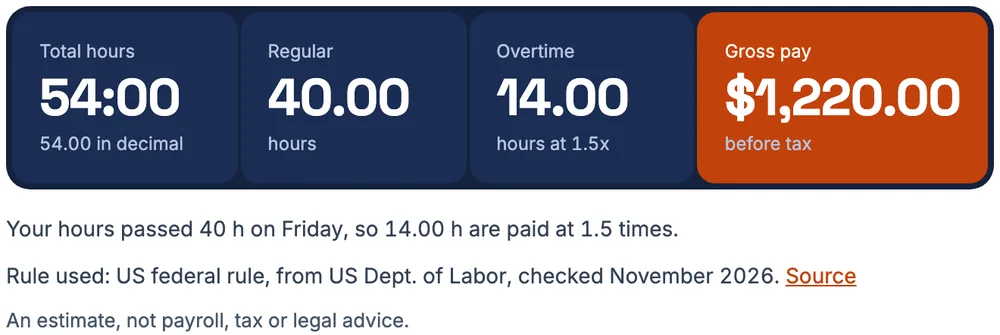
A simple example: you work five 9 hour days with no unpaid break, which is 45 h. At $20.00 an hour, the first 40 hours pay $800.00. The remaining 5 h are overtime, paid at $30.00 an hour, which adds $150.00. The week pays $950.00.
The calculator shows the same breakdown for your own hours. Each day carries a working line, and the overtime sentence under the totals says on which day the threshold was passed.
Choose The Overtime Rule For Where You Work
The US federal rule is the default. It pays time and a half after 40 hours in a workweek. A few states add daily overtime, and some countries work differently, so pick your rule from the list in Settings.
Rules change, and your job may be covered by more than one. These are the starting points the calculator uses, each with its source. Check them against your own state or contract.
| Rule | What it does | Source |
|---|---|---|
| US federal | Time and a half after 40 hours in a workweek, for covered hourly workers. | US Dept. of Labor |
| Alaska | Time and a half after 8 hours a day or 40 a week, for employers with 4 or more employees. | Alaska Dept. of Labor |
| California | Time and a half after 8 hours a day or 40 a week, double time after 12 hours a day, and a seventh-day rule. | California Labor Code 510 |
| Colorado | Time and a half after 12 hours in a workday or after 40 hours in a week. Colorado also counts 12 consecutive hours, which this tool does not check. | Colorado Dept. of Labor |
| Kentucky | Time and a half after 40 hours a week, and on the seventh day when all seven days of the workweek are worked. The weekly rule does not cover retail store, restaurant, hotel or motel employees, and this tool does not check that. | Kentucky Revised Statutes 337.050 and 337.285 |
| Nevada | Time and a half after 40 hours a week. Also after 8 hours in a day for workers paid under 1.5 times the state minimum wage, unless you agreed to a 4 by 10 hour schedule, which this tool does not check. Some jobs are exempt, such as executive, administrative and professional roles, some drivers and some commission sales work. | Nevada Revised Statutes 608.018 |
| Canada, federally regulated | Time and a half after 8 hours a day or 40 a week. Standard hours drop by 8 for each general holiday in the week, which this tool does not apply. Provinces differ. | Canada.ca |
These summaries are under review and may not cover every exception. An estimate, not payroll, tax or legal advice.
Weekly Overtime And Daily Overtime
Under the weekly rule, only the hours past 40 in a workweek are overtime. Five 10 hour days is 50 hours, so 10 h are overtime under the federal rule.
Under a daily rule, hours past a daily limit count too. In California, the same five 10 hour days give 10 h of overtime, because 2 hours a day are overtime.
Each hour is paid once, at the highest rate that applies to it. An hour that is both a daily overtime hour and over 40 for the week is not paid twice.
Double Time
Some states pay double time after a long day. In California, a single 13 hour day gives 8 h regular, 4 h at time and a half and 1 h at double time. The same day in Colorado has 12 h regular and 1 h of overtime, with no double time.
California also has a seventh-day rule. When you work all seven days of the workweek, the seventh day pays time and a half for 8 hours. After that it pays double time. Kentucky has a similar rule that pays time and a half on the seventh day.
| Rule | Regular | Time and a half | Double time |
|---|---|---|---|
| US federal | 13:00 | 0:00 | 0:00 |
| California | 8:00 | 4:00 | 1:00 |
| Colorado | 12:00 | 1:00 | 0:00 |
A single day under the US federal rule has no overtime. The weekly total is what counts.
Paid Time Off And Overtime
Hours you are paid for but do not work, such as holiday or sick pay, are not hours worked. They do not count toward the 40 hour threshold in the federal rule.
Mark those days as holiday, paid time off or sick in the time card. They add to your pay at your base rate, but they do not push your worked hours towards overtime.
Time And A Half Calculator: Pay By Hourly Rate
To work out time and a half, multiply your regular hourly rate by 1.5. For double time, multiply it by 2. The table does the sum for common rates.
| Regular rate | Time and a half | Double time |
|---|---|---|
| $10.00 | $15.00 | $20.00 |
| $12.00 | $18.00 | $24.00 |
| $15.00 | $22.50 | $30.00 |
| $18.00 | $27.00 | $36.00 |
| $20.00 | $30.00 | $40.00 |
| $25.00 | $37.50 | $50.00 |
| $30.00 | $45.00 | $60.00 |
| $35.00 | $52.50 | $70.00 |
| $40.00 | $60.00 | $80.00 |
Multiply the overtime rate by the overtime hours to get the extra pay.
How To Use The Overtime Calculator
- Open Settings and choose your overtime rule. Read the line under it, which names the rule and its source.
- Enter your hourly rate and any weekend or night premium.
- Type each day's start and end time, and the unpaid break in minutes.
- Read the totals for regular, overtime and double time hours, and the gross pay.
- Check the sentence under the totals. It says which day you crossed into overtime and what rate applied.
For a full list by state and country, see the overtime rules guide.
Questions People Ask
What is an OT calculator?
An OT calculator is an overtime calculator. It splits your week into regular hours, time and a half and double time, then adds up the pay for each.
How do you calculate time and a half?
Multiply your hourly rate by 1.5. At $15.00 an hour, time and a half is $22.50 an hour. At $25.00 an hour it is $37.50.
What does OT mean on a pay slip?
OT stands for overtime. It is the hours paid at a higher rate, usually time and a half, once you pass the weekly or daily limit.
How do I calculate overtime pay?
Multiply your regular hourly rate by 1.5, then by the overtime hours. At $20.00 an hour, 5 h of overtime pays $150.00 on top of the regular pay for the first 40 hours.
What is time and a half?
It means 1.5 times your regular rate. At $20.00 an hour, time and a half is $30.00 an hour. Double time at the same rate is $40.00 an hour.
Is overtime counted per day or per week?
Under the US federal rule it is counted per workweek, after 40 hours. Some states, such as California, also count it per day. Five 10 hour days give 10 h of overtime federally and 10 h in California.
Does a weekend premium change my overtime rate?
It can. With a $2.00 weekend premium, the example week's regular rate rises from $22.00 to $22.18, and overtime is paid at $33.27.
Do holidays and sick days count toward overtime?
No. Paid time off is paid, but it is not hours worked, so it does not count towards the 40 hour overtime threshold.
How many overtime hours is a 50 hour week?
Under the federal rule, a 50 hour week has 10.00 overtime hours, since the first 40 are regular. Under California rules, the same week of five 10 hour days has 10.00.