Biweekly Timesheet Calculator
A free biweekly timesheet calculator for two week pay periods. Enter each start and end time to get total hours, overtime counted week by week and gross pay.
The time card needs JavaScript. Nothing you type ever leaves your device.
Related Timesheet Calculators
How A Biweekly Timesheet Adds Up
A biweekly pay period is 14 days, which is two workweeks. Most employers pay for it on one payday, so your timesheet covers both weeks at once.
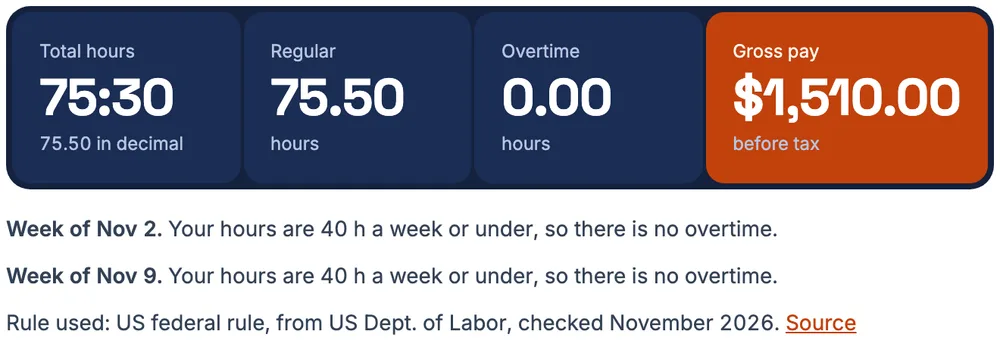
Here is a worked example. In the first week you work five days from 8:00 AM to 5:30 PM with a 30 minute lunch, which is 45 h. In the second week you work four days from 8:00 AM to 4:30 PM with a 30 minute lunch, which is 32 h.
The two-week total is 77 h, or 77.00 in decimal hours. At $20.00 an hour, that pays $1,590.00.
Overtime Is Counted Per Week, Not Per Pay Period
It is tempting to add the two weeks and compare the total with 80 hours. That is not how the US federal rule works. Overtime is counted for each workweek on its own, so a long first week cannot be offset by a short second week.
In the example, week 1 is 45 h, so 5 h are overtime. Week 2 is 32 h, so none are. The calculator keeps the two weeks apart, and the overtime hours are paid at time and a half.
| Hours worked | Regular | Overtime | Pay | |
|---|---|---|---|---|
| Week 1 | 45:00 | 40:00 | 5:00 | $950.00 |
| Week 2 | 32:00 | 32:00 | 0:00 | $640.00 |
| Pay period | 77:00 | 72:00 | 5:00 | $1,590.00 |
Treat the period as one block and 77 h is under 80 hours. No overtime would be paid, and the total would be $1,540.00. That is $50.00 short.
Your employer decides which day your workweek starts on. It is the same day every week, and it does not move with your pay period. If your pay policy says the week runs Sunday to Saturday, change "Week starts" in the settings to match.
What If One Week Is Much Longer Than The Other?
A swing like this is common in jobs with a heavy week followed by a light one. Take a first week of five 9 hour 30 minute days, which is 47 h 30 m. The second week is two 4 hour days, which is 8 h.
The total of 55 h 30 m is under 80 hours. Even so, 7 h 30 m of it is overtime, because week 1 went past 40. The time-card total shows both numbers, so you can see the overtime and the period total side by side.
Common Two-Week Patterns
Not every schedule is five days of 8 hours. Four days from 6:00 AM to 4:30 PM, with a 30 minute lunch, gives 10 hours a day. Two such weeks come to 80 h with 0 h of overtime, because each week is exactly 40 hours.
Fixed 80 hour schedules are easy to check, since both weeks are 40. Anything that moves hours from one week to the other changes the overtime, even if the two-week total is unchanged.
| Schedule | Hours a day | Hours in two weeks | Overtime in two weeks |
|---|---|---|---|
| 5 days, 8:00 AM to 4:30 PM | 8 | 80 | 0 |
| 5 days, 8:00 AM to 5:00 PM | 8:30 | 85 | 5 |
| 4 days, 6:00 AM to 4:30 PM | 10 | 80 | 0 |
| 5 days, 7:00 AM to 7:00 PM | 11:30 | 115 | 35 |
Each week is worked out on its own. Hours are paid at the regular rate up to 40 in the week, and the rest at time and a half.
Biweekly Pay From A Yearly Salary
A biweekly paycheck is one 26th of the yearly salary, before tax. Divide the salary by 26 to find it. The table shows common salaries.
| Yearly salary | Every 2 weeks (26) | Twice a month (24) |
|---|---|---|
| $40,000 | $1,538.46 | $1,666.67 |
| $50,000 | $1,923.08 | $2,083.33 |
| $60,000 | $2,307.69 | $2,500.00 |
| $70,000 | $2,692.31 | $2,916.67 |
| $75,000 | $2,884.62 | $3,125.00 |
| $80,000 | $3,076.92 | $3,333.33 |
| $90,000 | $3,461.54 | $3,750.00 |
| $100,000 | $3,846.15 | $4,166.67 |
Amounts are before tax and other deductions.
How To Use The Biweekly Timesheet
- Open Settings and check that the pay period says "Every 2 weeks". It is already set on this page.
- Type your start and end time for each day. Times like 8:30a, 830 or 17:30 all work.
- Add your unpaid lunch in minutes. If you would rather enter when lunch started and ended, use the time card with lunch.
- Enter your hourly rate to see gross pay, and read the working line under each day to check the maths.
- Use "Past periods" to look back, or "Copy last period" to start the new one from the old schedule.
Need lunch start and end times? Use the time card calculator with lunch.
Biweekly Or Twice A Month?
These sound alike, but they are not the same. Biweekly means every two weeks, which gives 26 pay periods a year, always starting on the same weekday. Twice a month means two fixed dates, such as the 1st and the 16th, which gives 24 pay periods a year.
A twice-a-month period can have 10, 11 or 12 working days, so its hours change from period to period. A biweekly period is always 14 days. If your employer pays on set dates, use the monthly calculator and pick "Twice a month" in its settings.
See the monthly timesheet calculator for date-based pay periods.
Keeping The Numbers Private
Your hours, rate and notes stay on this device. They are saved in your browser, not sent to a server, so there is nothing to sign up for.
The price of that privacy is that clearing your browser data removes your timesheet. Use the backup button to download a file now and then. Use the share link or PDF when you need to send a timesheet to someone else.
Questions People Ask
Is there a 2 week timesheet calculator?
Yes. This page is a 2 week timesheet and biweekly time card calculator. Enter both weeks, and it adds the hours, the overtime for each week and the pay.
What is a fortnightly timesheet?
It is the same as a biweekly timesheet. A fortnight is two weeks, so the period covers 14 days and 26 periods fit in a year.
How many hours is a biweekly pay period?
It is two workweeks, so 14 days. A full-time schedule of five 8 hour days is 80 hours. The example above, with a 45 hour week and a 32 hour week, comes to 77 h.
Is overtime calculated over 80 hours?
No. Under the US federal rule, overtime is counted each workweek after 40 hours. In the example, 5 h of overtime is paid even though the pay period total is under 80 hours.
How do I calculate biweekly pay from hourly pay?
Add the hours for both weeks and multiply by your hourly rate, then add the overtime premium for any week over 40 hours. In the example that is $1,540.00 at the regular rate plus $50.00 of overtime premium, which is $1,590.00.
How many biweekly pay periods are there in a year?
There are 26 biweekly pay periods in a normal year, because 52 weeks divide into 26 groups of two.
Can I change the day my week starts?
Yes. Open Settings and change "Week starts". Overtime is worked out for each workweek, so this matters when your hours are uneven.